The multilingual shift: voice agents are redefining customer service.
Routine calls, in any language, answered on the first ring. What that does to the support queue is obvious. What it does to the support job is the more interesting part.

For decades the support call followed the same script. A customer rang in, pressed their way through a rigid menu, waited on hold, and hoped to reach someone who spoke their language. On the other end, support staff spent their shift answering the same handful of questions: what time do you close, where is my package, can I change the card on file.
That pattern is breaking. Voice agents with real-time language understanding now take the routine calls outright. This is not the removal of the human from customer service — it is the removal of the part of the job nobody wanted, and the promotion of everything that is left.
Breaking the language barrier instantly
Language support has always been one of the hardest problems in a growing support operation. Staffing native speakers across ten, twenty or thirty languages, around the clock, is expensive to the point of being impossible for most organisations. So callers get routed into a queue that only clears when the right person is free.
A multilingual voice agent removes the queue entirely:
- +Immediate language identification. The agent recognises the caller’s language in the opening seconds, and follows them if they switch mid-conversation.
- +Accent and dialect precision. Rather than literal translation, context-aware models tuned for regional accents and local phrasing — so it sounds like someone from where the caller is from.
- +The same service for everyone. English, Spanish, Japanese or Arabic, the caller gets the same immediate resolution rather than a longer wait for a specialist queue.
Removing the transfer step is the whole point. The hold disappears, and so does the quiet signal a long wait sends about whose business is worth serving quickly.

From script-readers to problem solvers
To see why this changes the job rather than threatening it, it helps to look at how support volume is actually split.
Tier 1 is the routine: order status, contact details, opening hours, a booking or a pickup. Tier 2 is everything that needs a person: escalated troubleshooting, a dispute, a sensitive account conversation, anything where the right answer depends on judgement.
In most support organisations Tier 1 is the large majority of inbound calls, and it is the part that burns people out. The same question, several hundred times a week, is what drives fatigue and turnover — not the hard calls.
The agent works as an intelligent first tier. It resolves the standard requests on the call and keeps the backend systems current while it does. When a call needs human judgement it hands over cleanly, carrying the transcript and the verified details with it.
Why the human job gets better
The common fear is that automation hollows out the role. What actually happens is narrower and more useful than that: the volume drops, and the remaining work is the work worth doing.
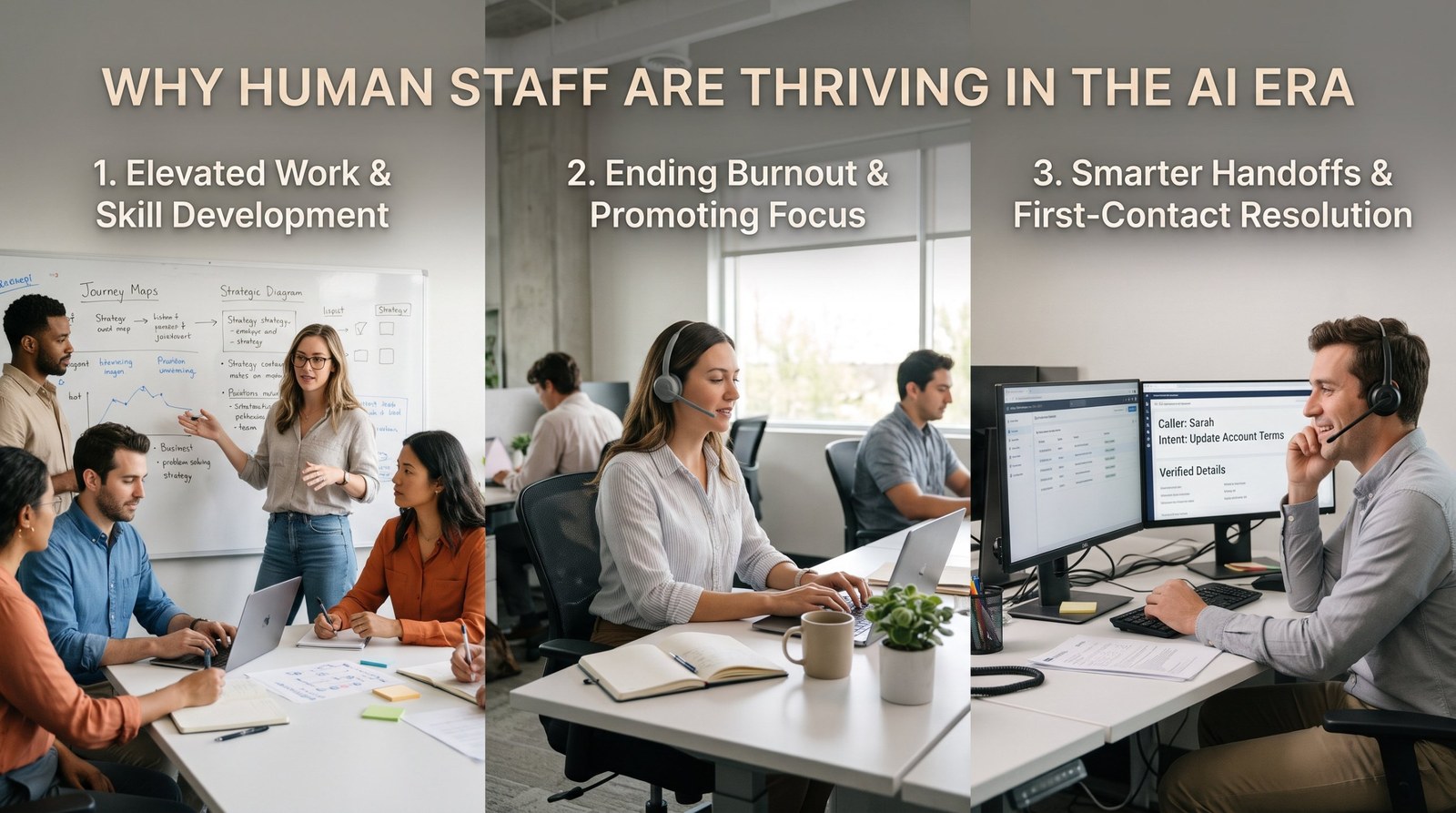
01Elevated work and real skill development
Freed from reading a script, staff move into work that compounds: account ownership, advocacy, genuine problem solving. Organisations that make this shift tend to start investing in the skills that match — critical thinking, negotiation, product depth, emotional intelligence — because those are suddenly the skills the role actually uses.
02The end of phone fatigue
Juggling a ringing phone against in-person duties or back-office work is a particular kind of stress, because neither task ever gets full attention. A voice agent acts as a buffer. Agents take fewer calls, but each one gets their whole focus, without the queue depth sitting in the back of their mind.
03Smarter handoffs, higher first-contact resolution
Nothing annoys a caller more than repeating themselves to a second person. When the agent escalates, it passes the caller’s name, intent and verified details straight to the representative’s screen. The conversation can open at the answer: “Hello Sarah, I can see you’re calling about updating your account terms — let me take care of that now.”
What actually changes, line by line
Set the two models side by side and the difference is less about speed than about where the effort goes.
The goal was never to take humans out of customer service. It was to take customer service out of the part of the job that was making people leave it.
A more human future for support
The rise of multilingual voice agents is not about removing people from customer service. It is about re-humanising the work.
Let the technology do what it is genuinely good at — processing quickly, bridging language gaps, resolving repetitive requests at three in the morning — and the human capacity that has been absorbed by all of that becomes available for the work that needs it. Staff move into more skilled roles, the operation runs with less friction, and callers get accurate help in the language they actually speak.
A first tier that never queues, and a handoff that never starts over.
Decible answers every support call instantly, identifies the caller’s language, and resolves the routine request end to end — updating your systems as it goes, not after.
When a call needs a person, it arrives with the transcript, the intent and the verified details already on screen. Your team picks up at the answer rather than the introduction.