From hold to sold: turning restaurant phone calls into reliable revenue.
Over 80% of calls to a restaurant are purchase-related. So why is the phone still the least reliable part of the ordering journey — and what would it take to fix it?
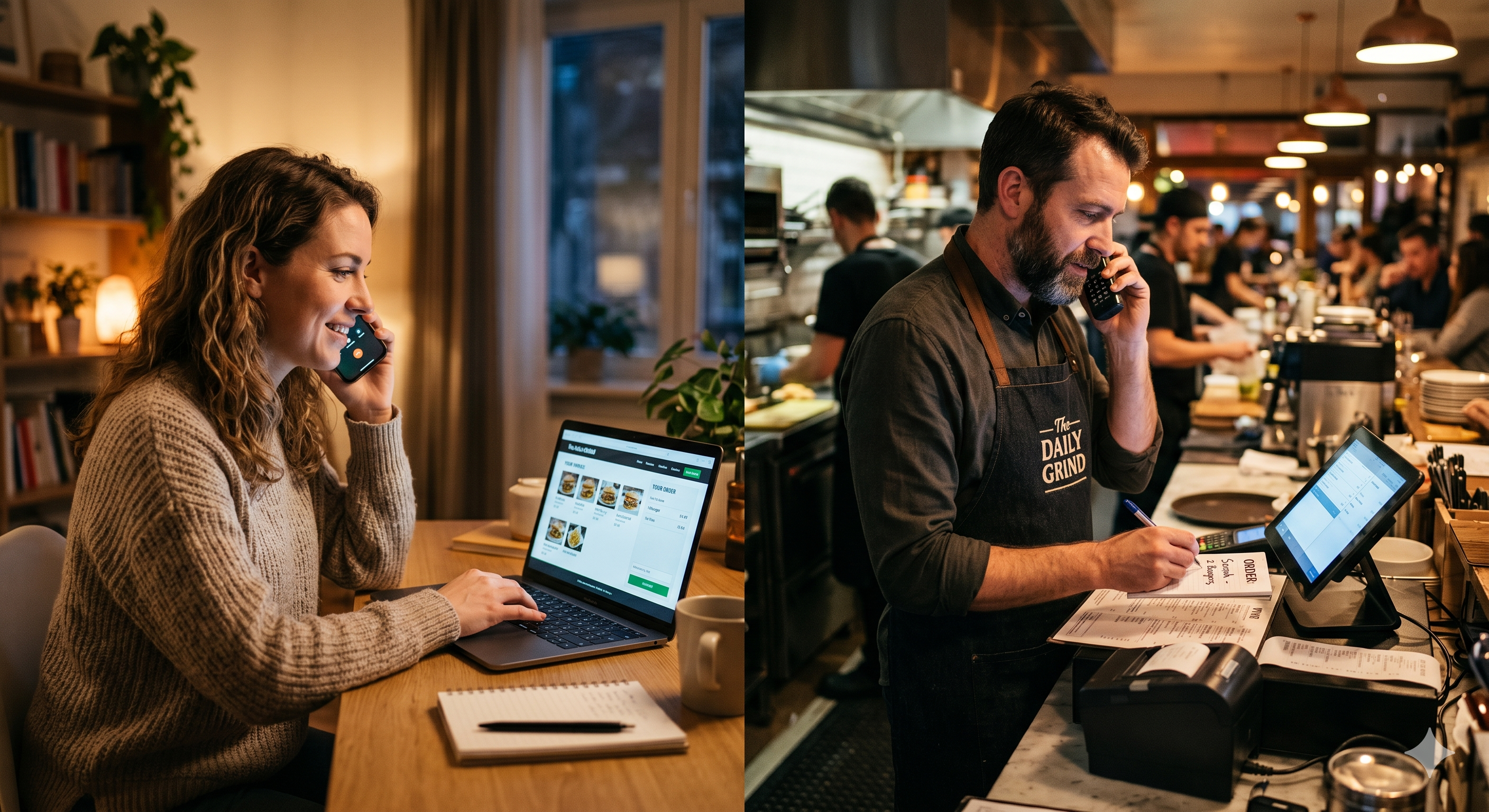
Yes, most of us click buttons on apps now — but the phone hasn’t disappeared from the dining experience. If anything, it’s become the channel we reach for when the order matters.
Why we still call instead of “Order Now”
Even in a world of “Order Now” buttons, here is when a customer still reaches for the phone:
- +I want to place a simple order quickly without opening an app.
- +I have a special request or allergy question that doesn’t fit neatly into an app checkbox.
- +I’m ordering for a group and need to talk through details in real time.
- +I’m confused by the online menu, the fees, or the pickup options and just want a straight answer.
But too often, the phone experience is the least reliable part of the ordering journey. The real opportunity isn’t to force everyone into apps. It’s to make the phone as smooth, accurate and reliable as the best digital ordering flow — so that when customers do call, because they care, the restaurant is ready to meet them there.
Pain point 01 · Just getting through
To the customer, it feels like:
- ”You don’t care if I order or not.
- ”I’ll just try the next place on the list.
Pain point 02 · The hold-time nightmare
When the call is answered, customers are often greeted and immediately put on hold while staff juggle the dining room, delivery drivers and tablets. Many callers hang up in under a minute and order elsewhere.
From a customer’s perspective, this feels like:
- ”My time doesn’t matter as much as what’s happening at the counter.
- ”If you’re this busy now, will you get my order right?
For the restaurant, every abandoned call is lost revenue and a potential negative review.
Pain point 03 · Distracted, rushed conversations
Even when you reach a human, they are often stressed, multitasking, and interrupting the order to handle something urgent in the restaurant.
- +The person on the phone sounds hurried, sighs, or keeps asking you to repeat yourself.
- +Mid-order, you’re suddenly put on hold to deal with something “urgent” in-store.
- +The call feels transactional rather than welcoming, details get missed, and errors creep in.
The hidden cost for owners
Customers feel the symptoms. Owners live with the causes.
- +Staff overload. Front-of-house teams burn out juggling phones, tables and delivery apps.
- +Revenue leakage. Missed calls, abandoned holds and lost upsells add up to thousands per year.
- +Operational risk. Wrong orders and missed allergy notes lead to remakes, refunds and bad reviews.
- +Inconsistent brand. Every call depends on who happens to pick up, so the experience is never the same.
What great phone ordering looks like
- +Fast, predictable call handling. Calls answered quickly, with little to no hold time.
- +A calm, attentive voice that repeats key details and treats the caller like a priority.
- +A clear order flow: contact info, items, modifications, allergies, payment, timing, pickup.
- +Simple, realistic timing and pickup instructions.
- +Consistent information that matches your online menu and in-store experience.
When your phone experience matches your digital experience, the phone becomes a bridge, not a bottleneck.
Can you deliver this without extra staff? Yes.
Better scripts, clearer processes and sharper training get you part of the way. But your team can only answer one call at a time, and peak hours will always create bottlenecks. That is where voice AI becomes a force multiplier.
How voice AI helps, without losing the human touch
A growing number of restaurants use AI phone answering to address exactly these pain points. These systems are designed to:
- +Answer and route more calls instantly, reducing missed orders and long holds.
- +Capture orders accurately with structured prompts, including allergy information and special requests.
- +Provide consistent answers to the usual questions — hours, menu basics, promotions — without tying up staff.
- +Hand off complex or sensitive situations to human staff when needed.
From the customer’s viewpoint, the win isn’t “more bots” for their own sake. It’s faster response, clearer communication and fewer errors, while still knowing a real person is available when it matters.
What we’re really asking for
When we call a restaurant, we’re not asking for perfection. We’re asking for respect for our time, our safety and our trust. Phone ordering today often falls short on all three, leaving customers hungry and owners exhausted.
If restaurants rethink phone ordering — through better training, clearer processes, or thoughtful use of technology — they can turn a fragile, frustrating channel into one of their strongest touchpoints for loyalty and revenue. From the customer side of the line, that is a change we would welcome with every ring.
Decible AI — a phone agent that feels human.
A voice assistant built for restaurants that answers every call instantly even at peak, takes orders end to end including allergies, spice levels and special requests, and collects everything your kitchen and front-of-house need before handing off cleanly to your team.
Your staff stay focused on the guests in front of them. Decible makes sure you don’t lose the ones on the phone — like adding one more reliable team member, without the hiring, scheduling or burnout.